
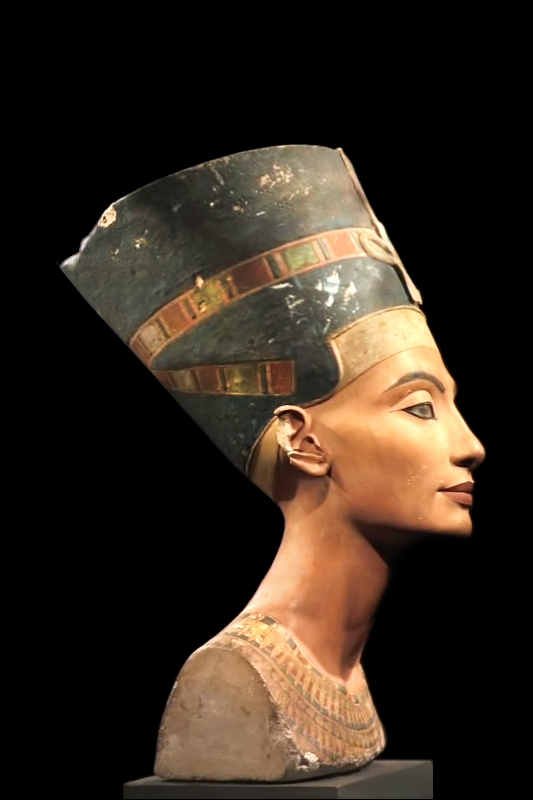
Bust of Nefertiti: The Most Beautiful Sculpture in the World?
Since its discovery in the early 20th century, the bust of Nefertiti, a work of limestone and stucco crafted by the sculptor Thutmose around 1345 B.C.E., has cemented the ancient Egyptian queen’s relevance as a global pop-culture icon.
Her portrait is perhaps the most beautiful sculpture the world has ever seen. The German Oriental Company uncovered the bust of Nefertiti on an expedition in Amarna in 1912. A sponsor of the excavation lent the sculpture to the Neues Museum in Berlin in 1913, where it has been housed ever since. Germany’s claim to the ancient artwork has been contested by Egyptian authorities and activists alike. Within this geopolitical landscape, a number of German artists have explicitly engaged with Nefertiti in their artwork as a means of exploring ideas about identity and ownership.
In his numerous works featuring Nefertiti, Awol Erizku, one of the greatest Ethiopian-American artists of the early twenty-first century, argues for Nefertiti’s utility as a historical reference point for black cultural dominion and extravagance. In Nefertiti (Black Power) (2018), the profile of the Egyptian queen is lit up with neon lights. As a medium that doubles as an advertising tool, neon lights are often used to intrigue consumers. This neon Nefertiti denies the viewer eye contact, drawing us in while keeping us at a distance. In Nefertiti—Miles Davis (2017), Erizku continues to connect Nefertiti with black culture, this time by transporting her to the 1970s, disguised as a disco ball.
For all the lore that surrounds Nefertiti’s image, very little is known about the life of the “beautiful one,” as she is called. In fact, Nefertiti largely disappeared from the historical record by the 12th year of her husband Akhenaten’s reign, when she was around 30 years old. Yet as an ancient muse, her cultural potency is only enhanced by this mystique. Without it, she would not be fit for the artistic and political projection that remains foundational to her posthumous reception. By inciting our engagement with the politics of race, gender, and colonial entitlement, Nefertiti has effectively surpassed the royal reach that once marked her dynasty. In exchange for this influence, she must remain a figurehead, her 21st-century fame marked by the disembodied power of a bust.
SOURCE:
“How Nefertiti Became a Powerful Symbol in Contemporary Art” by Jordan McDonald
https://www.artsy.net/article/artsy-editorial-depictions-nefertiti-way-society-views-gender-race
 The Dream